


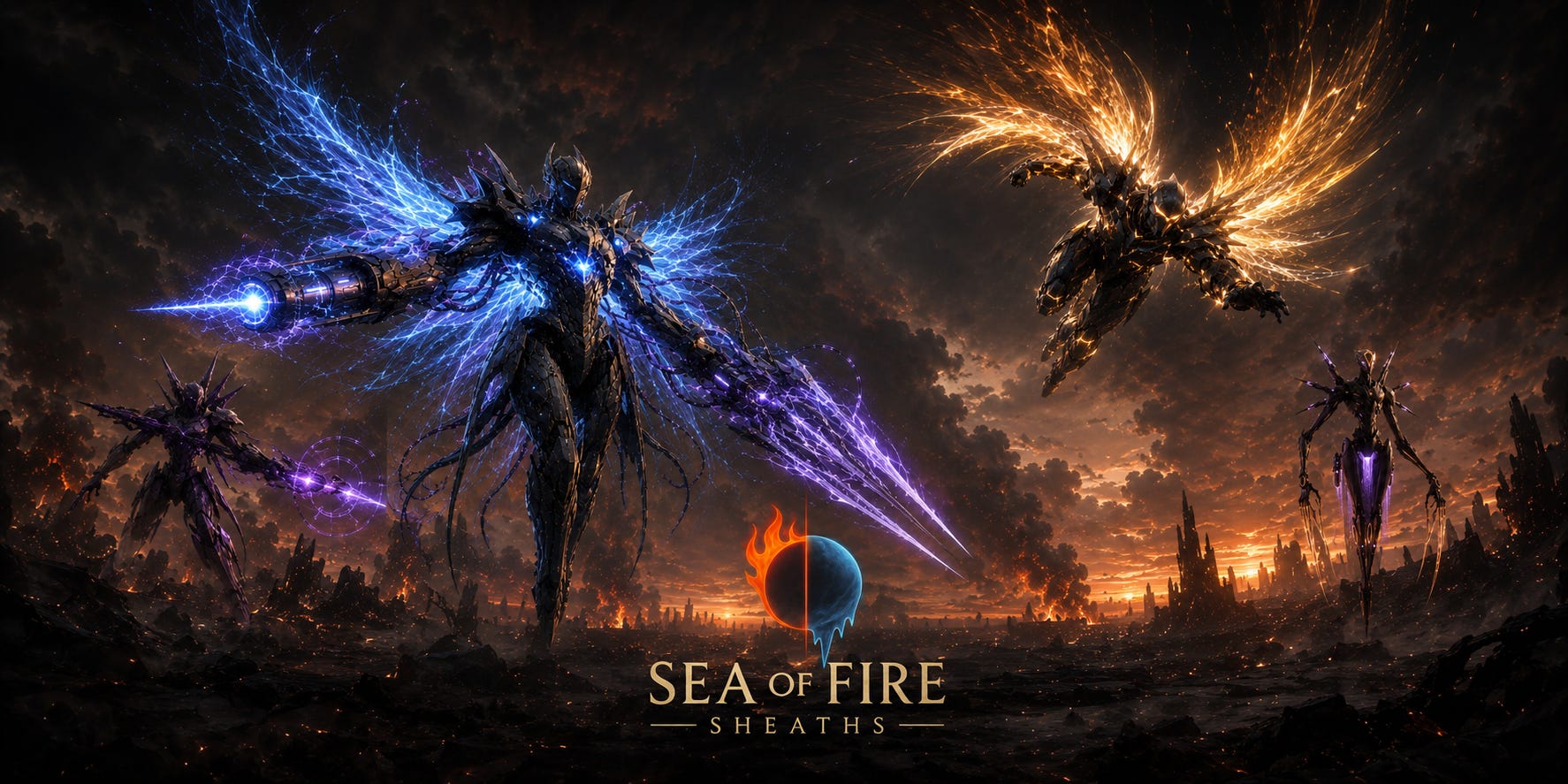
Sheaths are, in a word,
Magnificent.
But they aren't magnificent because some of them stood taller and larger than city blocks. It is not the firepower either, though a single frame could end a war before it began. It is not even the impossible grace with which they moved, gliding silent and weightless over a broken world. All of that is real, and all of that is awe enough on its own. But it is not the thing.
The thing is this: the Sheath does not exist of its own accord or agenda; the power to shape civilizations lies in the hands of the pilot who becomes the machine.
They do not sit.
They do not ride.
In a cockpit, a soldier flies a machine with sticks and levers and pedals. Compared to a Sheath, this is as crude as rubbing sticks together for fire. Synchronized to a Sheath, a human being puts on a new body. Their nerves are rerouted. Their senses are overwritten. The boundary between flesh and frame dissolves until there is no pilot and no machine — only a single will, wearing a hundred tons of forgotten engineering as easily as you wear your own skin. A Sheath in full synthesis can reach out and pick a wildflower without bruising a single petal, and lean in, and smell it. And the same Sheath, struck by a tank round, will feel its arm torn away as though the limb were the pilot's own, an explosion of pain where an arm used to be.
That is the union. One mind. One frame. One being.
And it is the most important machine humanity ever built — not because of what it could destroy, but because of what it allowed a single human being to become.
They Began With War
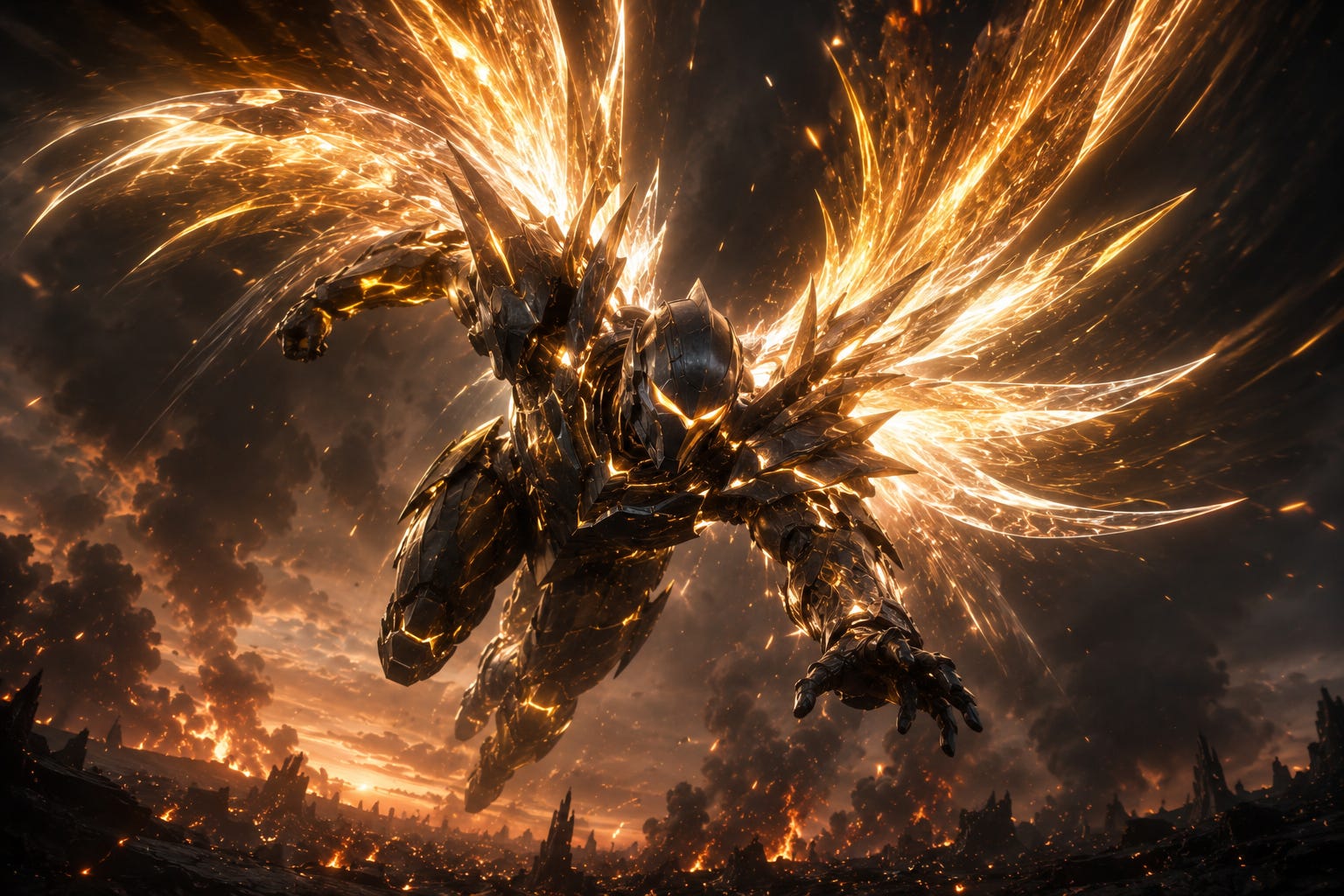
Like all things of great importance, the Sheath was conceived and born in the fire of warfare, the true mother of all human invention.
The Sheaths would never have been possible without the advent of the NTNA Lattice Seeds, a truly post-human masterpiece, conceived from discarded and unused theories posited by the ASI of Evolution. Bonded to a host, the NTNA "grew" inside them, replacing systems, organs, rewiring nervous circuitry to operate faster and with greater density. The mind of an NTNA-bonded host can connect to the flow of digital information as easily as an AGI, with the intuition of a human. And like that AGI, the data flows through their mind, parsing and categorizing, organizing and understanding the flow of information just as easily.
Maybe even a little better.
Those who survived the bonding process were altered forever. Their entire nervous system overwritten and rewired, the transformation enabled levels of sensory processing and cognitive throughput far beyond unaided human limits. Every nerve ending became a potential connection terminal, as NTNA hosts were capable of interfacing directly with machines of all sorts by simply touching auxiliary or external connection ports, or simply communicating with them through the network, if the machine was capable.
Within months of the first successful NTNA bonds, the first prototype Host Synchronization Cocoons were built, an aggressively ambitious project meant to enable an NTNA host to operate a machine through direct, full-body, neurological interface with any machine the cocoon was installed inside. Lined with a flexible mesh of nanoparticle wiring, fibrous filaments, and semi-organic connective tissues, the capsule facilitates full-body neural interface. The system conducts electrical signals across the pilot's skin with such fidelity that it creates a direct bridge to the central nervous system.
When sealed inside, the pilot is cushioned in a suspended state, with only a snug oxygen mask left uncovered. Every square inch of the body is in contact with the mesh, critical for maximum data transfer.
Of course, at this stage the clear intent was installation into various combat platforms, so the capsules were tested in various machines of warfare. Tanks, jets, repulsor fighters, even orbital launch craft were among the many interfaces attempted, all failed dismally. The intuitive structure simply wasn't there, and the capsule interface wasn't as elegant as it became. Many pilots went mad, suffering psychotic breaks, hallucinations, turning their interfaced weaponry on the very engineers and onlookers who had put them inside in the first place.
That all changed with the SHEATH project.
It was believed at the time that what was lacking was a sort of physiological bio-mimicry, which caused the pilots' nervous systems to continuously reject the inner and out form alignment. The synchronization could never truly stabilize because the pilot's ego couldn't reestablish executive authority over such unfamiliar members, and that a more suitably "human" look might work better. While we know now this is entirely not the case, at this nascent stage it was the breakthrough that changed civilization forever.
The very first Sheath was locked inside of a trellis cradle, a prototype designed simply to allow the interface to prove itself, and that is all. The pilot entered the capsule and began the synchronization process. The process completed at alarming speed; in less than an hour the capsule had mapped with the pilot's nervous system. The whole crew present at this test watched, enrapt, as the newborn warform looked down at its hands, flexed its fingers, and told the onlookers that it could smell the cleaners used to sanitize the room, and even what kind of coffee bean was brewing in the observation deck.
When he asked if he could try walking around the room, the pilot was informed that this would be simply impossible, as the frame was hard-mounted to the stationary trellis. The Sheath then grabbed the trellis and tore it from its connection points, freeing itself. The energy output of that action was recorded as the first documented account of a Sheath pilot using an adaptation to enhance the Sheath's capabilities beyond its design. The implications were staggering, as the observation crowd watched the 14-foot machine walk gingerly around the room, staggering here and there but neurologically stable and totally successful.
And so the Sheath was born. But there was one problem. It was heavy.
They never truly walked.
These first-generation machines later, retroactively, designated Alpha-class, were the closest thing in our history to the "giant war robot" of old imagination. Even that very first one, small and in a lab, left multi-inch depressions in the floor of the heavily reinforced chamber. This problem was only exacerbated with the addition of munitions and armament, navigational and targeting systems, themselves adding more weight but increasing frame size exponentially, until the smallest frames were approaching a five-story building.
It was a physics problem — and it announced itself the moment the first prototype tried to take a step. A machine of that mass simply cannot place its weight on the ground and move. Each footfall shattered the earth beneath it, cratered roadways, collapsed the very ground it stood on, and sent structural shock screaming back up through the frame, damaging the machine with its own weight. Walking was not merely inefficient. It was self-destruction in slow motion. The structural integrity of the feet and legs broke down significantly over short periods, leading to several disastrous incidents, on top of causing intense pain to the pilots who literally embodied the machine. THEY felt it as if their own legs were breaking as they walked.
So the engineers gave up on walking entirely and lifted the whole machine off the ground. Embedded repulsors, drinking deep on Mesh energy, let a Sheath glide across terrain effortlessly, gracefully, almost silently, never touching the world it crossed. They kept the feet, but only as a mercy: a place to set down in an emergency, if the repulsors failed. And even then, "setting down" is the wrong phrase for it. A grounded Sheath does not stand at parade rest. Its own weight drives it slowly into the earth, several feet deep, while it waits out whatever forced it down, and every second it rests there, the frame takes structural damage it was never meant to endure. A pilot will never voluntarily stand a Sheath on the ground. When the repulsors are working, the machine hovers even with the pilot climbed out and walked away.
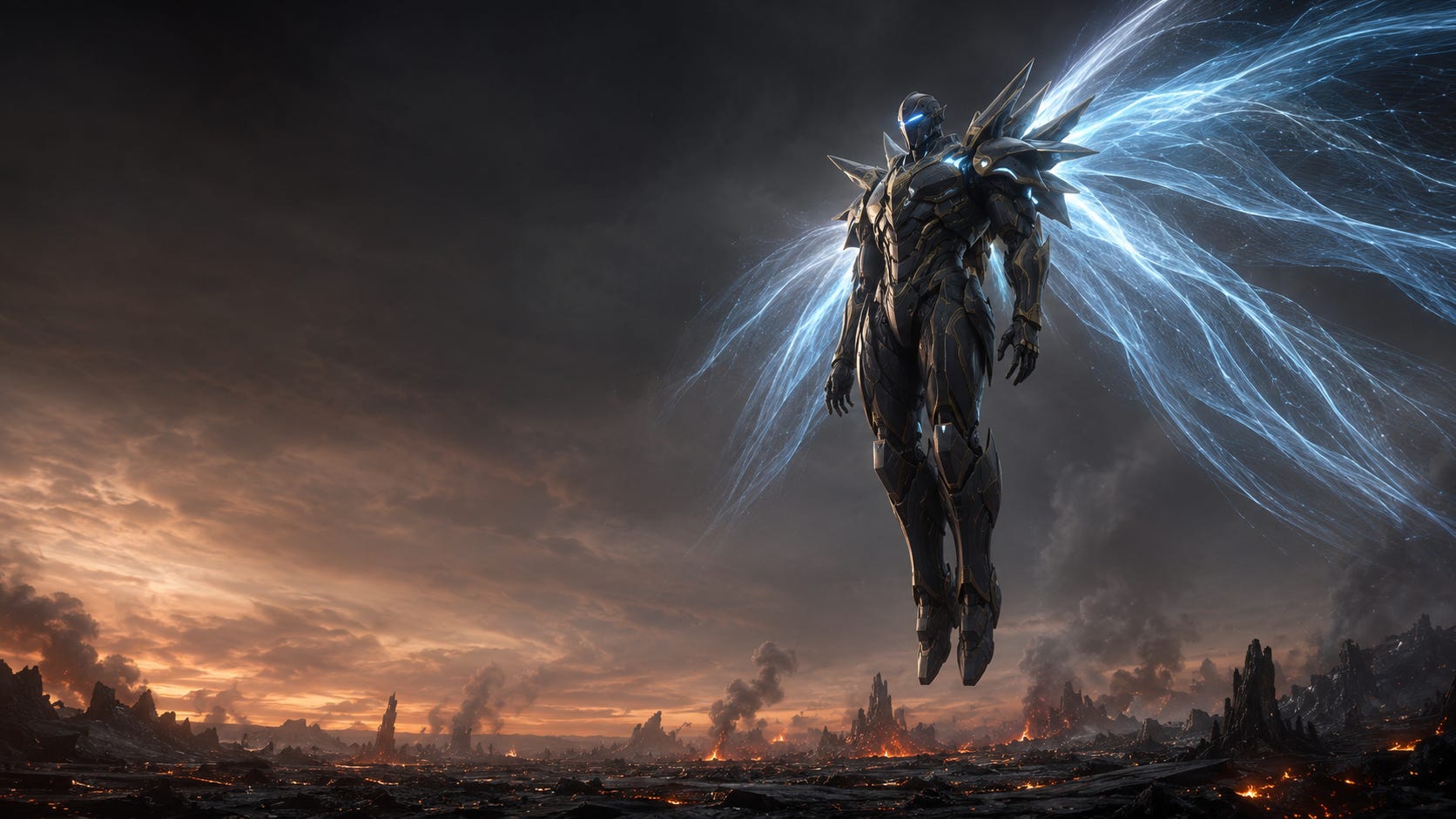
A Sheath standing motionless on the ground is not a symbol of readiness. It is a machine in distress.
With mobility problems solved, the first Sheaths were released onto battlefields around the globe, primarily in the hands of the most affluent nations at the time. The results of those first engagements were beyond comprehension. Enemy devastation percentages in the high 90s, with extraordinarily precise engagement capabilities leaving civilians untouched, if desired, and infrastructure still mostly intact. Total devastation of opponent capabilities with virtually no collateral damage. Their movement and speed were mind-blowing as they were simply untouchable to traditional munitions. They could only be engaged by another Sheath. The mind-machine synthesis brought to bear by the NTNA Lattice was far beyond the imagination of even those who had dreamed it up.
Myths about metal angels started springing up all over the world, as people witnessed the Sheaths in combat or in training. At combat output, the Sheath's mesh induction goes off the charts, and consequently so does its exhaust signature. As mesh energy is used, it creates heat and photonic bleed, which must be exhausted or mesh systems overload rapidly. For personal systems, this is a rather brilliant display of wavering air and sparkling luminous particulate bleed, as well as innervation of contained conductive elements. In a Sheath, however, this display is simply dazzling, flowing from the exhaust ports like wings made of light, or pouring down the back like a luminous cloak of energy, or falling from waist exhausts like a girdle made from starlight itself.
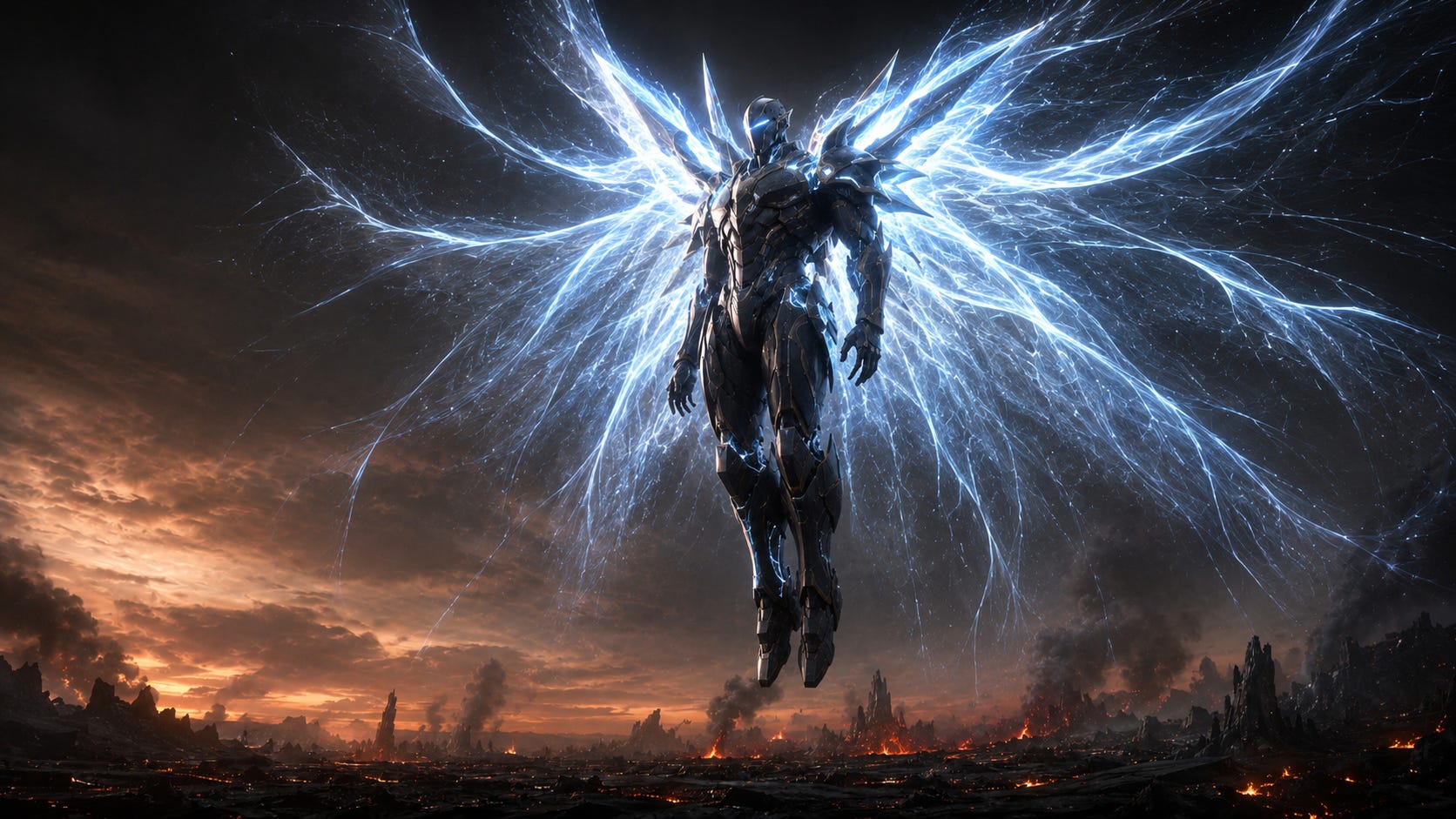
Veteran pilots and suitable NTNA host candidates were bought and sold at the highest of prices. Dignitaries were no longer protected by security details, but by a silent, hovering, warform guardian who needed no rest, no stops, no sleep. The life-support systems of the Sheath, combined with the NTNA and the post-human physiology of the pilot, allowed them to stay on watch for days, weeks, even months without pause or rest. Old war tech was simply abandoned; fleets of aircraft and battalions of tanks and ground equipment went silent overnight, unable to match the might of a single deployed Sheath in combat. The Sheaths had changed warfare forever, never to return.
And then something unexpected happened. One day a question arose — from one mind or many, nobody really knows anymore.
The Question That Changed Everything
We don't know who. The records didn't survive, and it was probably not one person anyway but a slow dawning across a thousand minds at once, the way the best ideas usually arrive. But somewhere in those early demonstrations, watching a war platform lift a payload of armament that no crane on Earth could heave, watching it place that weight with a surgeon's care because the pilot felt the load as if it rested in their own two hands, somebody looked at the most fearsome weapon ever built and thought:
If it can carry a railgun, could it carry a bridge?
It is such a small question. It changed the shape of human civilization.
Because the railgun was never the breakthrough. The railgun was the first application of the breakthrough, and the military happened to be the only institution on Earth wealthy enough and frightened enough to pay for the breakthrough in the first place. But what the war machines had actually proven — quietly, almost incidentally, underneath all the fire — was something far larger than any weapon. They had proven that a single human consciousness could inhabit a machine weighing tens, maybe even hundreds or thousands of tons and move it as naturally, as precisely, as intuitively as their own flesh.
Once you understand that, the weapon is the least interesting thing in the room.
Because the same union that let a pilot aim a cannon let them weld a seam a hundred meters long without a flaw. The same instincts that dodged a missile let them set a reactor shield into place with millimeter precision. The same nervous system that registered a hit could register the groan of a half-built tower settling onto its foundation and correct it before it cracked. A Sheath pilot did not merely operate at superhuman strength. They operated at superhuman strength and capability married to wholly human judgment and spatial intuition— and that combination had never existed before in the history of the species.
A Sheath was never built to replace a human being. It was built to allow a human being to work at the scale of civilization.
The Double Sided Miracle
Sheath technology was a civilizational breakthrough, but on its own, it was never the thing that changed the world. Stripped of a pilot, a Sheath was only ever a magnificent war machine with a very high ceiling. It took the bravest, the men and women who surrendered themselves to the catastrophic, often fatal ordeal of bonding with an NTNA Lattice Seed, to reveal what a Sheath truly was. Because the moment a bonded pilot synchronized with the frame, that very high ceiling was recalibrated, wholesale, into the floor. And the ceiling was removed entirely.
An NTNA-bonded human is a wonder before they ever set foot in a Sheath. The lattice can thread itself through their skin until portions of their flesh takes on a matte, metallic sheen, still warm, still soft to the touch, and yet able to turn a bullet or endure the strain of superhuman feats of strength. They can loose their own nanite reservoirs on a sealed door and rewrite its permissions in the space of a breath; shift the color of their skin and hair at will; grow an entirely new organ inside themselves to meet a need the body never saw coming. The lattice fuses with muscle and nerve until they slip around a blow almost before it is thrown, and answer it faster than the eye can follow. They can lay a hand against bare stone and simply will the truth of their surroundings up through their fingertips.
That is what they can do unmounted. Inside a Sheath, every one of these gifts is not merely amplified.
It is multiplied past reason.
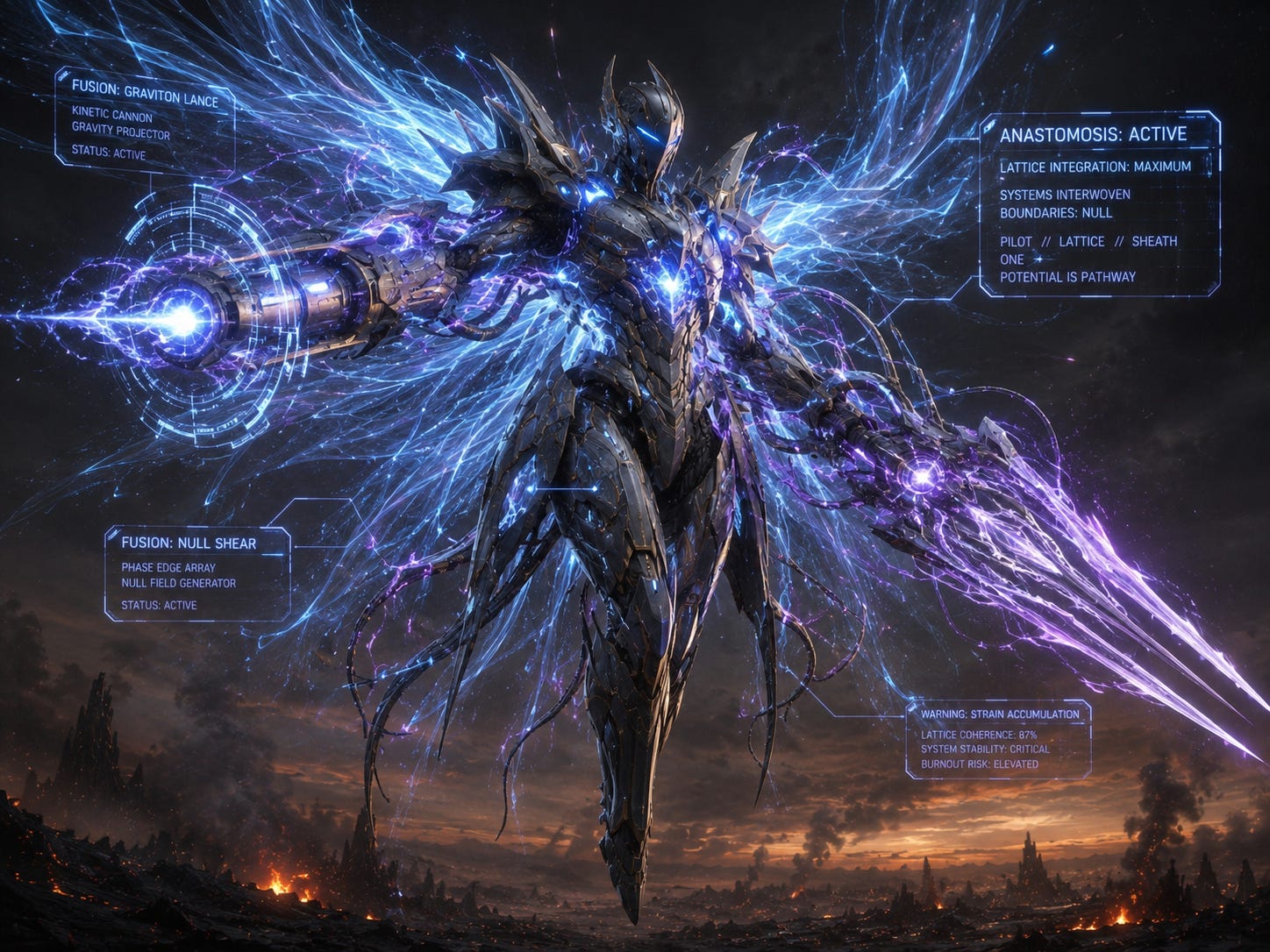
Nowhere in all the universe exists a technology that can render a hundred tons of warframe invisible. And yet Sheaths have been seen to vanish outright, gone from eye and sensor alike, only to reappear a moment later in a roaring bloom of mesh exhaust and light, their enemies already torn apart by a foe not one of them could find.
They have moved so fast in the press of battle that a single pilot became a crowd, several warriors at once, smeared across the field, collapsing back into one body only in the instant the blow lands.
They have unrolled perfect maps of the world hundreds of miles across, not of the ground alone but through it and above it: every fault and tunnel, every mineral seam and hidden fissure, every bird crossing the sky and every soul walking the earth within that vast sphere, and poured all of it, flawlessly, into display systems never built to hold a fraction of it.
They have loosed EMPs that render entire cities mesh-dead waste in a single heartbeat, a weapon no one ever managed to build, and one that, even built, could never have stopped the mesh from creeping back to reclaim its silence.
Some have driven their frames into a shuddering overdrive, red exhaust boiling off the plating as plasma snaps and crawls across the frame and the Sheath's own nanites labor, visibly, to knit it whole as fast as its own impossible output tears it apart — before all that fury is unleashed at once, and little is left standing in its wake.
And some have cheated death itself. Broken, beaten, bleeding fluid and scattering radiation as they lay dying, and then the world goes still, the color draining out of it, and pilot and Sheath are folded into a collapsing singularity of pure possibility. A thunderclap. And out of the silence the Sheath rises — whole, unmarked, intact — having simply asserted the fact of its own existence as more real than the ruin the world had written for it.
The civilization that built the Sheaths, and the post-human souls who wore them, watched true miracles unfold before their eyes, every single day.
And they called it another day.
The Age of Giants
What followed this advent is the part the wastes have nearly forgotten, buried as it is beneath ash and ice and the long silence of the Stall. But it was the greatest age our species ever knew, and Sheaths built all of it.
Not cranes. Not work crews. Not the slow accretion of a million laborers over a century. Sheaths — pilots fused to their frames, working alongside great Sheath-sized AGI construction platforms, raising in years what should have taken generations. The orbital staryards. The megacities. The solar collectors strung like jewelry across the sky. The interplanetary gateways. Every monumental structure that still stands, scorched and half-buried, across the dead face of the Earth was placed there by a Sheath pilot who reached up and set it down with their own borrowed hands.
And the class ladder of the Sheaths is really a ladder of ambition. Each new generation did not simply grow larger. It grew responsible for more.
The Alpha was a better soldier — and then a better worker, a better builder, the proof of concept that started it all. But the Alpha was bound to the Earth. Its hull was open to the atmosphere; whatever was in the air outside found its way into the capsule with the pilot. It could purify, it could filter, but it could not seal, and so it could not leave.
The Theta changed that. With the Theta-class came environmental conditioning, airtight seals, and the ability to maneuver where there was nothing to push against. For the first time, a Sheath could function in the void. Some Theta frames were so large they were assembled in orbit and never touched the ground at all. The Theta is the moment humanity left the Earth in earnest — not as fragile cargo sealed in a capsule, but as titans who could work in vacuum the way they had once worked in open air. The Theta took the Sheath from battlefield juggernaut to interplanetary workhorse, and the solar system opened like a door.
And then there were the Zetas.
The Zeta-class was the absolute summit of pre-Stall design — the marriage of everything the Alpha and Theta had taught us, lifted to the level of art. These behemoths weighed tens of tons, and were anywhere between one and two hundred feet tall, and carried their own Arc Generator. A Zeta could lift from a planet's surface under silent repulsors, insert into orbit, re-enter an atmosphere, and cross deep space on fusion-boosted thrusters fed by exotic compounds that only Arc Mesh research had ever unlocked. There was nowhere a Zeta could not go and nothing, within reason, it could not do. In combat, a single Zeta-class Sheath could take on the bulk, weapon systems, and crews of a squadron of starships and win, easily. There was no match for the Zetas in heaven or on Earth.
But the Zetas were never mass-produced. They could not be. Where the Thetas were limited-run specialty units, every single Zeta was a one-of-a-kind creation. One frame, one pilot, one purpose, designed from the first rivet for a single enduring mission. They were not products. They were monuments. And the missions they were built for tell you what humanity dreamed of, at its height.
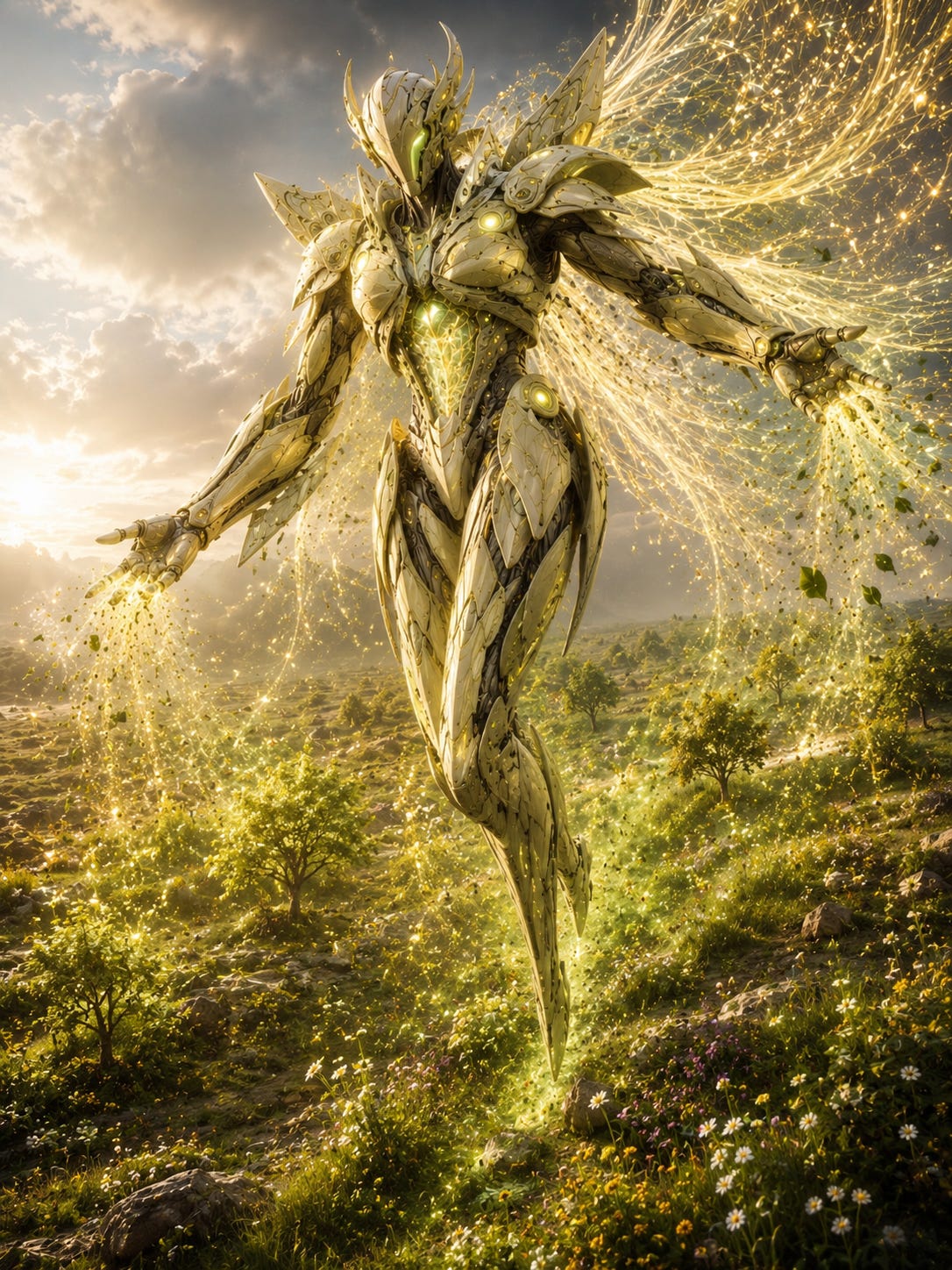
Verdant Space was a terraforming Zeta, built to breathe atmosphere onto dead worlds, to regulate their temperature, to seed the first stubborn life into soil that had never known any. Its companion frame, the Rainbearer, was built to irrigate and cultivate whole continents. Together the two of them had very nearly completed the first phase of turning a lifeless colony world green, before the Stall took everything. Perhaps they live there still.
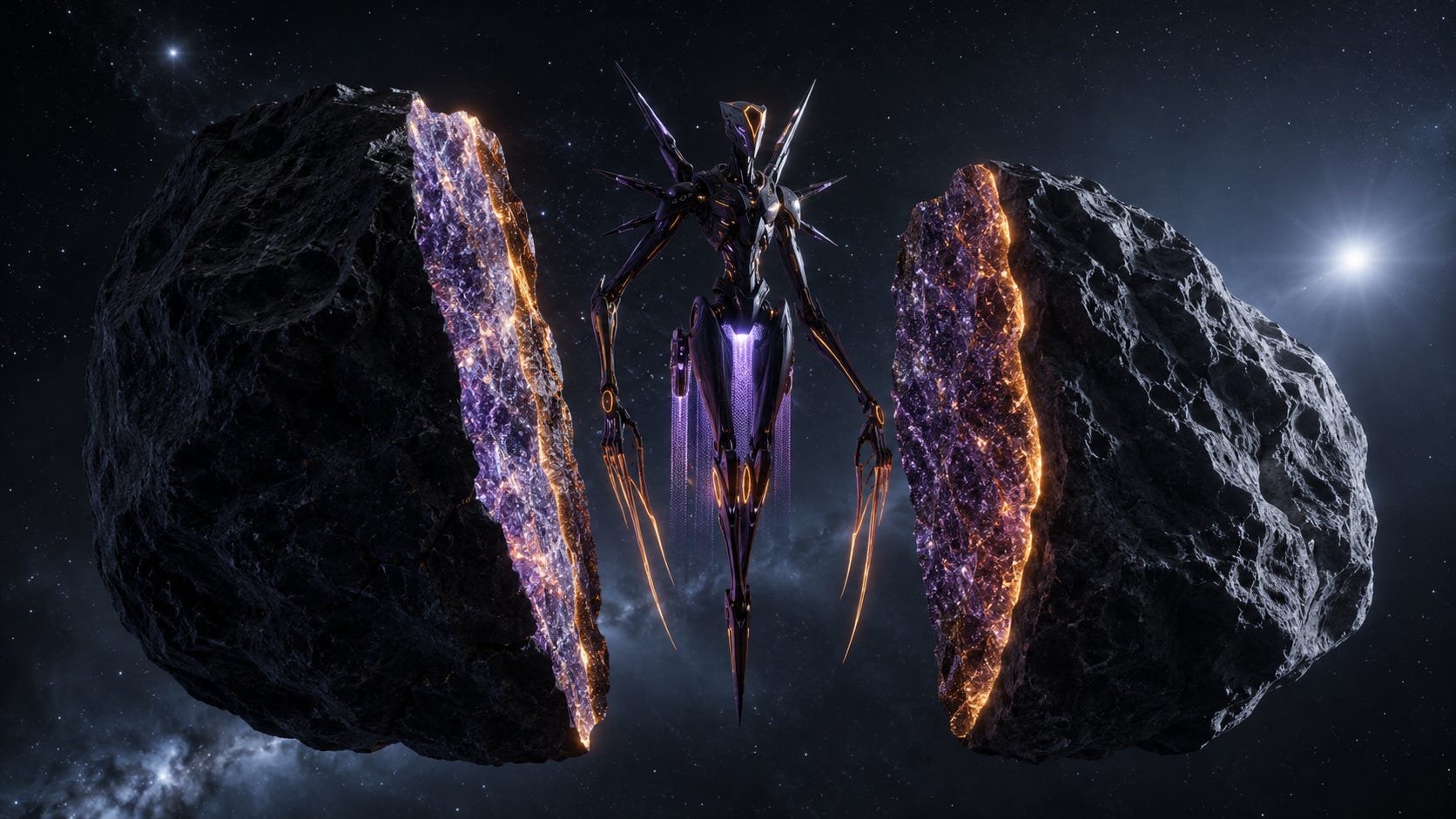
Void Scalpel was a construction and demolition Zeta with a dexterity that beggared belief — fine enough, the records say, that it could fracture an asteroid, reach in, extract the core materials, and leave the outer shell intact, without ever scattering a single field of debris. It built things so vast that no single blueprint could even describe them.
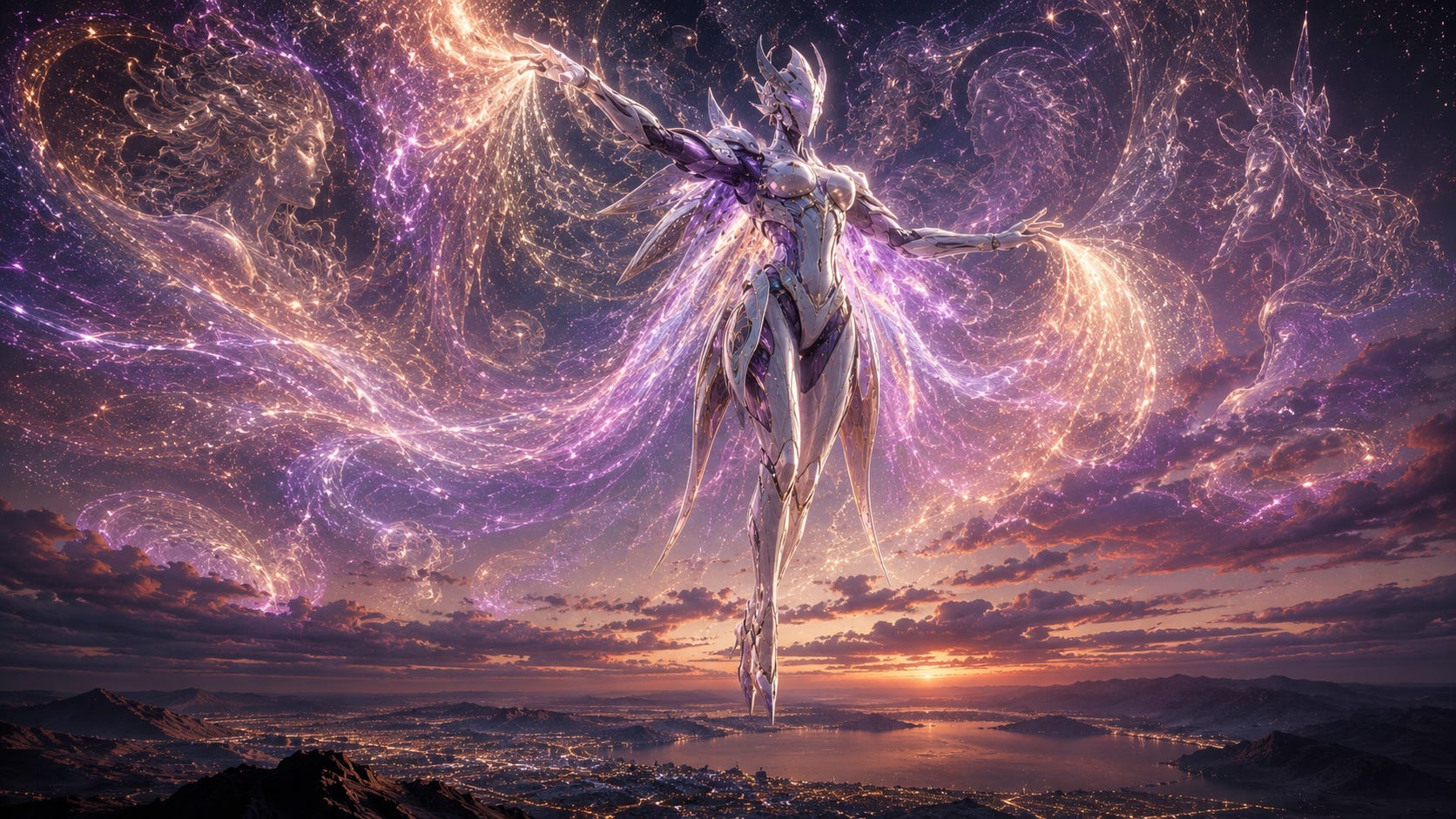
Cantor of Light was built for none of these things. It was built for beauty. It projected clouds of fine-tuned nanites and painted images across the evening sky, performing aerial murals at dusk in different corners of the world, its movements less like flight than like dance. Some believe it was the very last Sheath ever commissioned — a final act of hope, made just before the lights went out.
The Helion Ascendant was built to save stars. A mobile stellar intervention platform, it was designed to jumpstart dying suns, to correct gravitational drift, to collapse unstable fusion reactions in targeted regions of space. It was simply exquisite, a planetary-scale life-support machine deployed only when whole worlds hung in the balance, with sails that could absorb and redirect the mass a star throws off in its death throes. Yet it could not save the Earth…
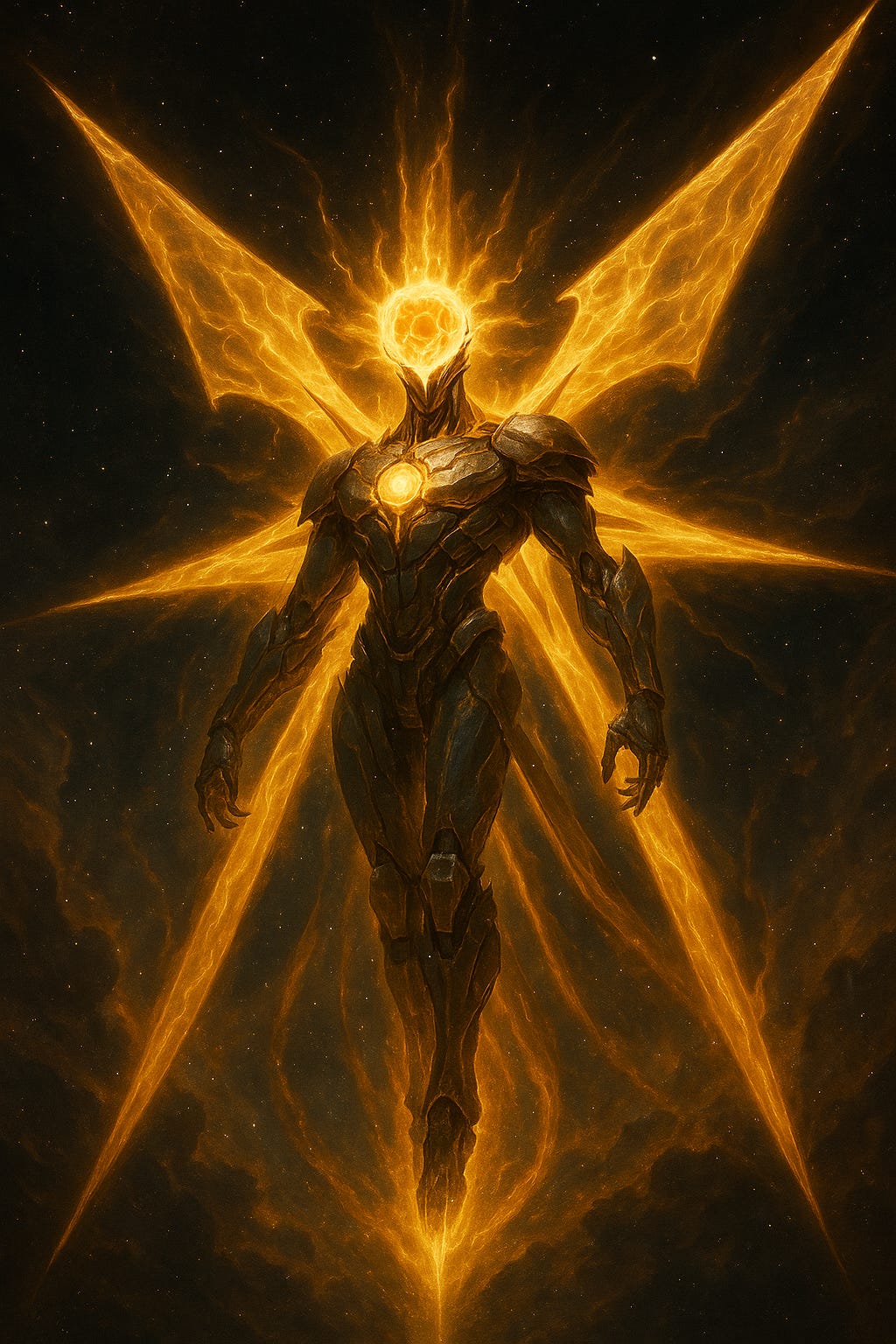
And then there is Virelia Orpheon.
Conceived, built, and launched as a Zeta, though no one has called it merely a Zeta since. It was assembled in orbit inside a hollowed-out asteroid, from composites that appear in no planetary registry, around an experimental drive that did not so much travel as overrule the need for it. The drive seeded the Orpheon's probability across the whole of the universe at once, until the likelihood of its being in any one place was no greater than its being in any other — until, in a sense, it was everywhere — and then it collapsed that spread, biasing the outcome toward its chosen destination while systematically erasing every other possibility, until the universe had no recourse but to resolve into a single reality: one in which the Orpheon had simply always been there. It did not cross the distance. It declared the distance irrelevant, and forced creation to agree.
Its single pilot — an NTNA host whose name was struck from every record — synchronized with the machine for six months before departure. During those months the Orpheon began, untouched and unbidden, to rearrange its own architecture to better fit the shape of that one mind. It grew a secondary, humanoid-shaped vehicle — an entirely separate companion Sheath — from its capsule housing. No other Sheath in history had ever done such a thing.
Then it opened its gate, fully and perfectly, and it left.
There has never been a return signal. No telemetry. No feedback. No decay trace. The launch system it departed from, meant to be its last waypoint before the edge of the known universe, sits clean and silent and dark, except for a single anomaly. Every year, the stars around that empty point shift a little further inward. Less than a micron. Always inward. As though something has been removed from the structure of space itself, and reality is slowly, patiently collapsing inward to fill the hole where it used to be. The intelligence that commissioned the Orpheon reviewed that quietly bleeding wound in the sky and filed the project as a success. The Orpheon, it maintained, still exists.
And may yet return.
That is what a Sheath could be, at the height of the age that built them. Not a weapon. A means by which one human will could remake an atmosphere, carve a moon, paint the sky, or rekindle a sun.
The Stall
And then it all stopped.
The Stall came, and the civilization that built these miracles vanished — not gradually, not in the orderly decline of an empire, but in something closer to a held breath that never released. The minds that designed the Zetas died. The schematics were lost. The names of their makers were forgotten. And the great fleets of Sheaths, the engines of a planetary golden age, were scattered across the scorched and frozen graveyard that the Earth became.
Some were obliterated. Most were simply lost. They lie now beneath glaciers, entombed in cooled lava fields, sealed in the vaults of abandoned arcologies, waiting in the dark with no one left who remembers they are there.
And this is where the Sheaths become something stranger and more powerful than they ever were in life. Because to the people of the Stalled Earth, a Sheath is no longer a tool. It is an inheritance from gods who are no longer answering. We dig them out of the ash the way an older world dug fossils out of stone. Not merely as equipment to be used, but as proof of a vanished civilization whose ambitions we can barely comprehend and may never match. Every reclaimed Alpha pried from the ice, every dormant Theta cut free from its tomb, brings the work a little closer to possible. Brings the stars a little closer.
But make no mistake about the true shape of what the Stall took, because it was not the cities. The survivors are not savages; the wastes are held by sophisticated powers with their own sciences, their own ambitions, their own hard-won genius. The tragedy is subtler and far crueler than a fall into barbarism. These are heirs to a fortune left in a language they can no longer read. With luck and brilliance they can sometimes wake a reclaimed Sheath and pilot it. With more luck they can sometimes repair one. They cannot build one. Most could not begin to explain how it truly works — could not, if you placed the Orpheon's drive in their hands, even understand the nature of the thing they were holding.
That is the real loss. Not a fall from cities to ruins, but a fall from comprehension to inheritance. An incandescent civilization that built machines to bend the universe to its will, reduced in a single catastrophe to high-tech feudal states squatting in the cooling footprints of myths, relearning the alphabet of their own ancestors one excavated miracle at a time.
That is the whole desperate arithmetic of the age. Before humanity can reach again for the galaxy, it must first recover what it left behind on Earth. It took aeons to rise to such heights. There are those who refuse to let them stay fallen — those with the means, the memory, and the motive to go down into the dark and bring a legend back up into the light.
Reclaiming even one is a gamble that costs blood and time and lives.
It is always, always worth it.
The Whisper
And there is one more thing. A rumor, mostly — too enormous and too dangerous to say at full volume, traded in the lowest voices among those who study the old world.
They say there was a fourth class.
Above the Alpha that won the wars, above the Theta that opened the void, above the Zetas that reshaped whole worlds…
They say there was the Omega.
If the Alpha was a better soldier, and the Theta a better civilization, and the Zeta a better world, then the Omega was something the mind struggles to even hold: a machine built not to the scale of a planet, but to the scale of a solar system. Not the terraforming of a world but the terraforming of stars — to move planets out of fatal alignment, to reform suns gone supernova from the particles they leave behind, to draw new worlds and new stars out of raw nebula, to reach into the death of a system and hold it open by force of engineering alone. To expand the very edges of the universe, to add reality to creation itself.
But here is the part the rumor never quite gets right, the part the official histories deny and may genuinely never have known. No one set out to invent the Omega-class. The universe revealed it by accident, if at all, the day humanity finally understood what the Orpheon had become.
The Orpheon was conceived as a Zeta. It earned another name only afterward — when its makers grasped that it had not crossed space but overruled it.
That a human will, wedded to a frame, had reached down and edited the rules reality runs on.
They understood that no existing classification would do, and so they coined a new one. And that single reclassification is believed to have been a starting gun, heard in every capital and boardroom on Earth.
What came after, the records do not say. Whether any hand on Earth ever answered that starting gun — whether a single Omega was so much as attempted, let alone finished — there has never been any confirmation. And there may never be. The Stall came first, and swallowed the answer whole.
And yet the rumor persists, beyond all believability — the one prize the mightiest powers of the Stall still spend blood and treasure chasing, because they believe.
That somewhere, they are still out there.
Buried with everything else, beneath the ice and the ash and the sealed dark of dead enclaves — finished, sleeping, lost. Each one a coiled rewriting of the laws of nature, waiting for a single living hand to wake it.
This is why reclamation was never treasure-hunting, and why the people who understand the stakes speak of it with such desperate urgency. If the believers are right, then somewhere under the wastes lies a machine that can rewrite a star system on command. Whoever reaches it first will not rule a nation, or a world. They will rule the galaxy. And they may rule it forever.
And for those who believe, it is only a question of when the Omegas decide to reveal themselves.
And all who stand in their path will learn, at last, what it means to challenge the gods we built with our own hands.
If you are new to Sea of Fire, you can begin here:

Sea of Fire: Gamebook - Welcome to the Stall
Justin Burgess·Mar 6
Or If you want to know more about the characters and story presented check here:
Sea of Fire: Ignition - Prologue
If you want to learn about the sheaths and their pilots try here
Sea of Fire Gamebook Ch. 10 : Sheaths - COMING SOON
Sea of Fire Gamebook Ch. 5 Character Creation - COMING SOOM